

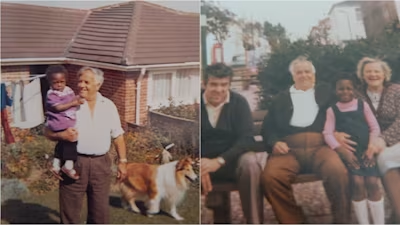
For this year’s Black History Month, we are honouring Black Britons who champion social work and honour our communities. Meet Toyin Okunuga, a care-experienced author suddenly taken away from her foster family. Discover her story this Black History Month. Last time, we spoke about Symon Basterfield, foster care and participant in landmark documentary 70 Up.
Who is Toyin Okunuga?

Toyin Okunuga’s early years were turbulent. Her birth parents came to the UK on student visas in the 70’s to study and work, placing Toyin in a newspaper advertisement to be privately fostered.
This was not uncommon at the time. Between the 1950’s to the 1970’s, thousands of West African children and babies were fostered via newspapers and childcare journals, with The Times in 1968 reporting that up to 5,000 West African children were privately fostered in Britain each year.
Like Toyin’s birth parents, many of these children were born to students who were also working full-time jobs. These arrangements happened with little formal oversight in a process informally known as farming.
‘The only black girl in the village’
Before becoming an author, speaker and consultant, Toyin was two months old when she was moved to Leicestershire with a white foster family – with whom she developed a close and loving relationship.
Toyin was the only black girl in the village, something she’s said that she was blissfully unaware of until she was much older. Her experience was, for much of her childhood, a positive one.
“I owe all these people all the gratitude I have because without them I might not be here,” she said.
Her fostering experience was overwhelmingly positive, until it came to an end.
Everything changed when, at eight years old, Toyin was suddenly taken back to Nigeria by her birth family.
Toyin described the separation from her foster family as deeply traumatic. She wasn’t able to say goodbye to the people who had raised her, and ger foster grandparents died without her seeing them again.
Without a formal foster care process, Toyin did not get the chance to learn about her ethnic heritage and culture. She’s expressed difficulty adapting to a completely different environment, culture and family life she was unfamiliar with.
Toyin faced further trauma in Nigeria, where she was sexually abused from the age of twelve. She describes her experience as “desperation. There were no checks in place.”

Formalising foster care and supporting cultural belonging
Toyin eventually moved back to the UK. She was able to reconnect with her foster family, with children of her own. She became an author, and her memoir ‘Hush to Roar’ confronts her past and navigates her journey to recovery.
Alongside the release of films like ‘The Last Tree’ and ‘Farming’, individuals like Tosin joins other privately fostered West Africans in speaking out over the last few years about farming. Private foster care is now regulated, local authorities must be informed of these arrangements so they can assess the suitability of the carer and offer support. Yet even so, accounts from care-experienced individuals like Tosin remain largely unrecorded.
Toyin’s story reminds us that foster care experiences does not end when a child leaves care. Today, there is a formal process that ensures degrees of support and care once children in care mature to independence. Foster families are also offered cultural and anti-racism training, to support connections to heritage, culture and a sense of belonging.
Want to foster?
If you’ve been thinking about fostering, even if it’s just a “maybe one day”, we’d love to chat. There’s no pressure and no question too small. Give our friendly fostering advisors a call on 0800 989 0135 or message us via the website.
